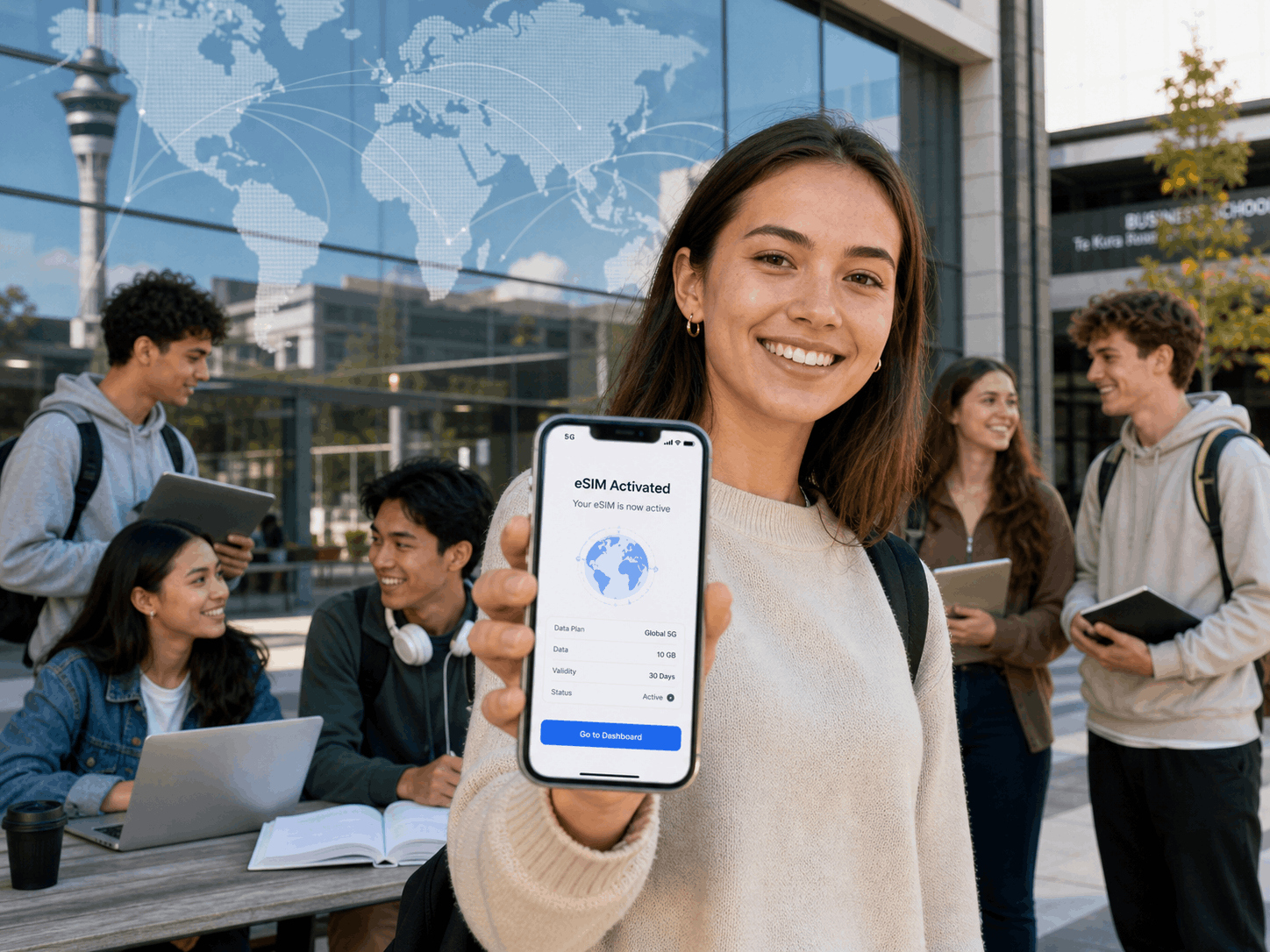
The Digital Student Nomad: How Global Connectivity is Transforming New Zealand Education in 2026
NeoNet Education NZ explores how connected learning, international mobility, eSIM technology, and modern education infrastructure are reshaping the student experience across Aotearoa New Zealand.
Introduction: New Zealand Classrooms Are Becoming Global Classrooms
New Zealand education has always been shaped by distance. From rural learners studying far from major cities to international students crossing oceans to join our institutions, access has long been one of the defining challenges of the sector. In 2026, however, the meaning of access is changing. It is no longer limited to whether a student can enter a classroom. It now includes whether they can connect, collaborate, research, publish, and participate from anywhere in the world.
The modern student is increasingly a digital student nomad: a learner who may attend lectures in Auckland, complete fieldwork in the Pacific, join a research group in Europe, and submit assignments from a temporary accommodation space overseas. This is not simply a lifestyle shift. It is a structural transformation in how education works.
For New Zealand schools, universities, polytechnics, training providers, and education technology teams, this shift demands a new mindset. Connectivity can no longer be treated as a convenience. It is part of the learning environment itself. In the same way that libraries, laboratories, and classrooms support academic success, reliable digital access now supports participation, equity, research quality, and student wellbeing.
At NeoNet Education NZ, this transformation connects directly to our ongoing commitment to Information Technology in education. Digital systems, connectivity tools, cloud platforms, student support technologies, and secure communication infrastructure are now central to the academic journey.
The Rise of International Field Research
New Zealand students are increasingly involved in research that extends beyond national borders. Environmental science students may study coastal resilience across the Pacific. Public health researchers may join international projects on disease prevention. Business students may conduct market research in Asia. Education students may observe comparative teaching models overseas. Indigenous studies scholars may collaborate with communities across different regions and cultural contexts.
This expansion of learning beyond the campus creates powerful opportunities. It allows students to work with real-world data, build international networks, experience different systems, and understand global challenges through direct engagement. Yet it also creates a practical question: how can students remain connected while moving between countries, networks, institutions, and research sites?
In 2026, connectivity is increasingly being recognised as a student right, not a luxury. A student conducting field research needs access to maps, translation tools, safety contacts, cloud storage, research databases, ethics documentation, supervisor communication, and emergency support. Without reliable connectivity, academic mobility becomes unequal. Students with greater financial resources can stay connected more easily, while others face barriers that affect their research quality and personal safety.
Reliable connectivity supports:
- Academic continuity: students can access learning management systems, lecture recordings, research files, and institutional email while abroad.
- Fieldwork accuracy: researchers can upload notes, geotag observations, sync survey results, and preserve data in real time.
- Student safety: travellers can contact supervisors, family, accommodation providers, embassies, and emergency services.
- Collaboration: students can remain active in group projects, virtual seminars, and research meetings.
- Equity: affordable connectivity reduces the gap between students who can easily pay for roaming and those who cannot.
Challenges of Modern Roaming for Students
While the language of global education is inspiring, the practical experience can be difficult. Students often travel with limited budgets, complex itineraries, and a need to manage academic responsibilities across time zones. Traditional mobile roaming has not always served them well.
The most common challenge is cost. International roaming charges can become unpredictable, especially when students move between multiple countries or need data for research activities such as uploading images, attending video meetings, or accessing cloud-based academic platforms. Even when roaming packages are available, students may find the terms confusing or restrictive.
Another challenge is reliability. A student may arrive in a new country and discover that their home provider has weak partner coverage, slow data speeds, or limited support. In fieldwork environments, connectivity can vary significantly between urban centres, rural regions, and remote study locations. This affects not only convenience but also research integrity.
Students also face administrative friction. Buying a local SIM card may require identity verification, local addresses, store visits, language support, or payment methods that are not easily available to international visitors. For short-term academic travel, the effort required to secure local connectivity can consume valuable time and create stress at the beginning of a study trip.
Key barriers include:
- High international roaming fees and unclear billing structures.
- Limited access to affordable short-term data plans.
- Difficulty buying local SIM cards immediately after arrival.
- Inconsistent network quality across research destinations.
- Data caps that restrict video calls, cloud syncing, and academic downloads.
- Security concerns when relying on public Wi-Fi networks.
The Financial Burden of International Research Travel
International research travel is rarely cheap. Flights, accommodation, insurance, transport, visas, field equipment, conference fees, and food can place pressure on students and their families. Connectivity is sometimes treated as a small detail, but for students on limited budgets it can become a meaningful financial burden.
This is particularly important for students who need to travel for academic purposes but do not have access to large scholarships or institutional funding. A student presenting at a conference, joining a short-term exchange, or conducting field interviews may need dependable mobile data every day. If the only option is expensive roaming, the cost of participation increases.
Education providers should therefore consider connectivity planning as part of student mobility preparation. Just as students are advised to organise insurance, accommodation, and academic approvals, they should also be guided toward affordable and reliable mobile data options. This is where modern eSIM tools can make a significant difference.
Essential Tools for the Digital Scholar
The digital scholar of 2026 needs more than a laptop and a student email account. They need a practical toolkit that supports learning, mobility, communication, research, and safety. This toolkit should be simple enough for undergraduate students but robust enough for postgraduate researchers and academic staff.
Essential tools include:
- Cloud storage: for secure backup of research notes, images, recordings, and academic documents.
- Password management: for protecting institutional accounts while travelling.
- Multi-factor authentication: to reduce the risk of account compromise.
- Offline access: downloaded maps, readings, consent forms, and emergency documents.
- Virtual meeting tools: for supervisor check-ins, seminars, and collaborative projects.
- Connectivity planning: affordable mobile data that works across borders without traditional contract friction.
For students and educators looking for free or low-cost data options for academic travel, eSIM Free can be a useful resource when planning connectivity for exchange programmes, international research travel, and short-term study abroad. Instead of relying only on expensive roaming or waiting to purchase a physical SIM card after arrival, students can explore eSIM-based options that may help them stay connected for academic purposes with less financial pressure.
The key advantage of eSIM technology is flexibility. Students can often prepare before departure, activate data more quickly, and avoid physically swapping SIM cards. For learners moving between countries, this can reduce friction and support more consistent academic participation.
Traditional SIM vs. eSIM for Study Abroad
| Comparison Area | Traditional Physical SIM | eSIM for Study Abroad | Student Impact |
|---|---|---|---|
| Setup | Often requires visiting a store, inserting a physical card, and sometimes completing local registration. | Can usually be installed digitally on compatible devices using a QR code or app-based activation. | eSIM can reduce arrival stress and help students connect faster. |
| Flexibility | May be tied to one country or provider unless the student buys another SIM. | Can support regional or country-specific data plans depending on the provider. | Useful for multi-country research, exchanges, and conference travel. |
| Device Handling | Requires removing and storing the home SIM, increasing the risk of loss. | No physical card swap is required on compatible phones. | Students can preserve their home number while using travel data. |
| Cost Control | Local SIMs can be affordable, but setup may be inconvenient; roaming can be expensive. | Prepaid eSIM plans can make data costs clearer before travel. | Better planning can reduce unexpected bills. |
| Academic Use | Works well once active, but access may be delayed after arrival. | Can support immediate access to maps, email, cloud files, and learning systems. | Improves continuity for fieldwork and study abroad. |
Student Checklist for Global Connectivity
Before leaving New Zealand for study, research, exchange, or conference travel, students should treat connectivity as part of their academic preparation.
- Check whether your phone supports eSIM technology.
- Confirm that your device is unlocked and can use overseas data plans.
- Research mobile coverage in your destination, especially if travelling outside major cities.
- Download offline maps for fieldwork areas and transport routes.
- Save emergency contacts, supervisor details, insurance information, and accommodation addresses offline.
- Enable multi-factor authentication before travelling.
- Back up key academic files to secure cloud storage.
- Prepare a data plan before departure rather than relying only on airport Wi-Fi.
- Use institutional VPN guidance where required for secure academic access.
- Keep a backup communication method in case your primary data connection fails.
The Future of EdTech in New Zealand: 5G, eSIM, and Real-Time Collaboration
The future of education technology in New Zealand will not be defined only by devices or platforms. It will be defined by connected ecosystems. As 5G coverage expands, eSIM adoption increases, and cloud learning platforms become more advanced, students will expect education to follow them across borders, campuses, homes, workplaces, and field sites.
Real-time remote collaboration will become a normal part of academic life. A student in Wellington may collaborate with a supervisor in Christchurch, a research partner in Singapore, and a community organisation in the Pacific. Field observations may be uploaded instantly. Data analysis may happen in shared cloud environments. Video feedback may replace delayed email chains. International guest lectures may become routine rather than exceptional.
For educators, this creates new responsibilities. Course design must account for mobile participation, different time zones, digital accessibility, and the reality that students may not always be physically present. Assessment models may need to support remote evidence collection, multimedia submissions, and collaborative digital outputs. Student support services must also adapt, ensuring that learners abroad can still access guidance, wellbeing support, technical help, and academic advice.
For institutions, the strategic challenge is integration. Connectivity, cybersecurity, learning design, cloud infrastructure, and student mobility cannot be treated as separate topics. They are part of the same transformation. A strong education technology strategy must connect the physical campus with the digital campus and the global learning environment.
Conclusion: Connectivity Is the New Academic Infrastructure
The digital student nomad is not a distant future concept. It is already emerging across New Zealand education. Students are learning across borders, collaborating across time zones, and using digital tools to participate in academic life from wherever their research or study takes them.
In 2026, the institutions that succeed will be those that understand connectivity as academic infrastructure. Reliable data access, secure systems, mobile-first learning design, and practical student guidance will shape educational quality as much as lecture theatres and libraries once did.
For New Zealand educators, the opportunity is significant. By supporting connected, mobile, globally aware learners, we can help students participate more fully in international research, exchange, and collaboration. By treating connectivity as part of our commitment to Information Technology in education, we prepare students not only to study in a global world, but to lead in one.