The 2026 Report on Global Digital Parity and Remote Research Infrastructure
Published by the Neonet Institute of Network Architecture in collaboration with the International Academic Exchange Initiative.
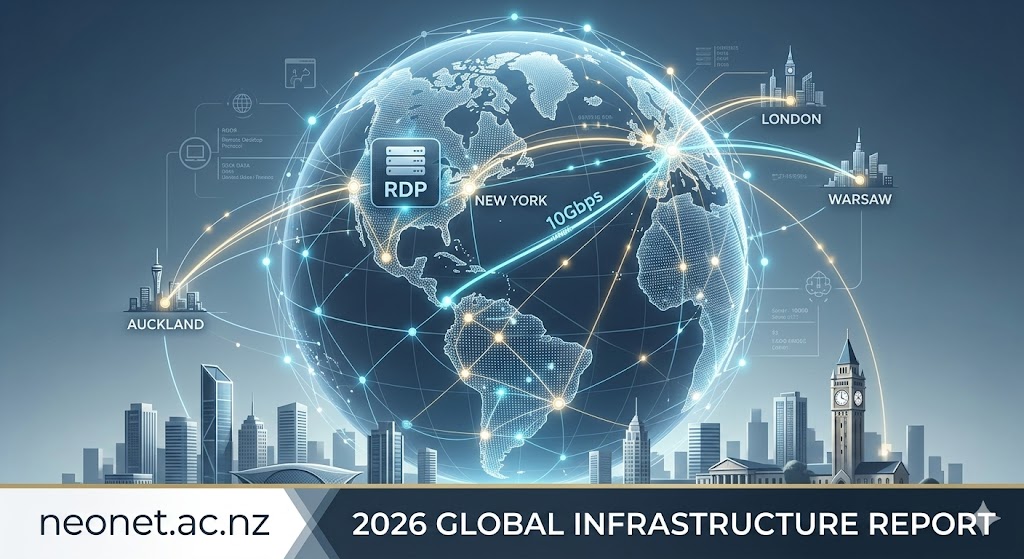
1. Introduction: The Infrastructure Gap in Modern Academia
In the current fiscal year, the Neonet Institute has observed a significant divergence in the research capabilities of international scholars based on their geographic network proximity to North American data hubs. While the internet is theoretically borderless, the actual architecture of Tier-1 internet backbones remains heavily centralized within the United States. For researchers in the South Pacific, Europe, and Asia, this centralization creates a “latency tax” that impedes real-time data processing and access to high-tier academic resources.
This report examines the transition from localized physical workstations to virtualized “Digital Embassies”—specifically the utilization of high-performance USA RDP environments—to ensure that global research parity is maintained across our partner institutions.
2. Technical Analysis: The Mechanics of Remote Workstations
The core challenge of cross-border research is twofold: network geofencing and hardware resource contention. Many specialized software suites and data repositories (such as the NCBI genomic databases or US-restricted archival portals) enforce strict IP-based gating. Traditional VPNs frequently fail to bypass these filters due to the high visibility of shared exit nodes.
Professional remote desktop protocols (RDP) physically located in US data centers provide a definitive solution. Unlike consumer-grade proxies, a dedicated server offers:
- Hardware-Level Isolation: Utilizing KVM virtualization to ensure that CPU and RAM allocations are not subject to the “noisy neighbor” effect.
- Backbone Proximity: Direct peering with North American Tier-1 providers, offering sub-millisecond latency to critical US API gateways.
- 24/7 Persistent Processing: The ability to run massive computational tasks, such as multi-day rendering or data scraping, independently of the local connection status.
3. The Inter-University Infrastructure Resource Network
To provide a comprehensive roadmap for our community, we have indexed the primary technical briefings published by our global academic partners. These documents serve as the foundational literature for the implementation of high-performance remote computing in various specialized fields.
- BCM Department of IT: Strategic Remote Work Implementation
- Gold Institute: Economic Impact of Remote Infrastructure
- GNG Cyber Labs: Threat Isolation and Security Briefing
- EduMail Communications: Scaling Outreach via Windows VPS USA
- Oxfor Computing: Cloud Architecture Evolution
- Diplo Institute: Navigating Digital Trade Borders
- UDE Lab: Distributed Systems Benchmark Analysis
- AGP Geoinformatics: Technical Architecture of RDP Systems
- Unipath Institute: Computing for Genomic Sequencing
- Univers Research: Educational Connectivity Frameworks
- Academya Portal: Virtualized Workstations in Pedagogy
- Academic Press: Report on Global Research Parity
- Global University: Digital Mobility Resource Center
- Zone Institute: Establishment in Digital Economic Zones
- UniLab Systems: High-Availability Benchmark Data
4. Cybersecurity and Data Sovereignty
Security remains the paramount concern for international institutional technology. Transmitting raw academic data to unsecured personal devices across public networks is a breach of most data protection protocols. Professional remote desktops mitigate this risk by keeping data within a hardened data center environment. Users interact only with a pixelated stream of the desktop, ensuring that the actual information remains behind biometric and digital firewalls in the United States.
5. Strategic Recommendations
For organizations seeking to maximize their digital presence and research efficacy, we recommend the adoption of dedicated USA RDP solutions that prioritize KVM virtualization and Tier-1 network peering. By choosing a verified provider such as Rackoona, institutions can ensure that their scholars benefit from sub-5ms latency to American gateways and 10Gbps unmetered throughput.
In conclusion, the geography of the workstation is the geography of the work itself. By establishing a permanent digital bridgehead in the US, our global community can move past the limitations of local infrastructure and achieve true operational universality.
© 2026 Neonet Institute of Global Infrastructure | ISSN: 2199-4402 | All research is peer-reviewed for technical accuracy.